


Healthcare Content Marketing helps healthcare providers attract patients, build trust, and improve online visibility by creating valuable, SEO-optimized content. Through educational resources, patient-focused content, and digital marketing strategies, healthcare organizations can increase engagement, strengthen credibility, and drive long-term patient growth.
Healthcare content marketing builds trust with patients and drives organic traffic by combining SEO-optimized educational content, personalized patient resources, and data-driven digital strategies. Providers who invest in consistent, accurate, and empathetic content see stronger patient acquisition, better retention, and measurable ROI.
Healthcare organizations face a challenge most industries don’t: they must earn trust before they ever meet their audience. A patient researching symptoms, comparing specialists, or evaluating hospital systems isn’t just making a purchasing decision—they’re making a decision that affects their health, their family, and sometimes their life.
That’s what makes healthcare content marketing so powerful, and so demanding. Done well, it positions your organization as a credible, compassionate resource at every stage of the patient journey. Done poorly, it erodes the very trust you’re trying to build.
This guide covers everything healthcare marketers, hospital administrators, and medical practice managers need to know—from building a foundational content strategy to optimizing for search engines and emerging AI platforms.
What Is Healthcare Content Marketing?
Healthcare content marketing is the practice of creating and distributing valuable, accurate, and relevant content to attract and engage patients, caregivers, and healthcare professionals. Rather than relying solely on traditional advertising, healthcare content marketing draws audiences in through education, transparency, and genuine utility.
Content types vary widely: blog posts explaining medical conditions, patient education videos, symptom checkers, physician spotlights, email newsletters, and downloadable guides all fall under this umbrella. The goal isn’t just awareness—it’s action. Whether that’s booking an appointment, signing up for a wellness program, or simply trusting your institution enough to return when care is needed.
According to the Content Marketing Institute, 78% of consumers say they prefer organizations that provide custom content over those that don’t. In healthcare, where patients arrive already anxious and overwhelmed, that preference becomes a competitive advantage.
Why Healthcare Organizations Need a Content Marketing Strategy
Ad spend alone won’t cut it. Patients increasingly research providers online before ever picking up the phone—Google reports that 77% of patients use search engines before booking a healthcare appointment. Without a content marketing strategy, your organization is effectively invisible during the most critical phase of the decision-making process.
A well-executed healthcare marketing strategy delivers several tangible outcomes:
- Increased organic traffic through healthcare SEO
- Greater patient trust through authoritative, accurate information
- Lower patient acquisition costs compared to paid media
- Stronger patient retention through ongoing engagement
- Improved health literacy among the communities you serve
Beyond acquisition, content marketing supports healthcare inbound marketing—a methodology that attracts patients to you rather than chasing them through outbound tactics. When a patient searches “what to expect after knee replacement surgery” and lands on your detailed, compassionate guide, you’ve already begun building a relationship.
How to Build a Healthcare Content Marketing Strategy
Defining Your Audience and Patient Personas
Effective medical content marketing starts with understanding who you’re talking to. A children’s hospital serves parents making anxious decisions on behalf of their kids. A cardiology practice serves older adults managing chronic conditions, often alongside their adult children. A telehealth platform may serve busy professionals who prioritize convenience above all else.
Develop patient personas that capture:
- Demographics: age, location, income, health literacy level
- Pain points: what health concerns are they researching?
- Information preferences: do they prefer video content, long-form articles, or short FAQs?
- Trust signals: what makes them choose one provider over another?
These personas should directly inform every piece of content you create, from blog post topics to the reading level of your patient education materials.
Setting Goals Tied to Patient Outcomes and Business Metrics
Every healthcare content marketing effort needs measurable goals. Generic targets like “increase brand awareness” aren’t actionable. Instead, tie your content goals to specific metrics:
- Increase organic website traffic by 30% over 12 months
- Grow appointment bookings from content by 20% quarter-over-quarter
- Reduce call center volume by improving self-service patient education content
- Improve patient satisfaction scores by enhancing pre-appointment communication
When goals connect to real outcomes, it becomes much easier to prioritize topics, allocate budget, and demonstrate ROI to hospital leadership.
Medical Content Marketing: What to Create and Why
Patient Education Content That Genuinely Helps
Patient education content is the backbone of effective healthcare content creation. When patients understand their conditions, treatment options, and what to expect from care, outcomes improve—and so does satisfaction.
This content should be:
- Accurate: reviewed or authored by licensed clinicians
- Accessible: written at a 6th to 8th grade reading level where appropriate
- Actionable: answering the question “what do I do next?”
- Empathetic: acknowledging the emotional dimension of health decisions
Strong patient education content includes condition explainers, treatment comparison guides, pre-procedure checklists, post-discharge care instructions, and FAQ pages that anticipate real patient concerns.
Hospital Content Marketing: Showcasing Expertise and Humanity
Hospital content marketing often needs to accomplish two things simultaneously: demonstrate clinical expertise and communicate warmth. Patients want to know their provider is skilled—but they also want to know they’ll be treated with dignity and care.
Physician profiles, patient success stories (with appropriate consent and HIPAA compliance), behind-the-scenes content, and community health initiatives all contribute to this dual goal. These human-centered stories are also highly shareable on social media, extending your reach without additional paid spend.
Healthcare SEO: Ranking for the Queries That Matter
Healthcare SEO is the process of optimizing your content so it surfaces when patients search for relevant terms. This involves both technical SEO (site speed, mobile optimization, structured data) and content SEO (keyword targeting, internal linking, topical authority).
Key healthcare SEO principles include:
- Target long-tail keywords: “How long does recovery take after hip replacement?” drives more qualified traffic than “hip replacement.”
- Build topic clusters: Create a pillar page on a broad topic (e.g., diabetes management) and support it with related subtopic articles.
- Optimize for local search: Most patients seek care close to home. Ensure your Google Business Profile is accurate and that your content targets location-specific terms.
- Meet E-E-A-T standards: Google’s quality guidelines place extra scrutiny on health content. Your content should demonstrate Experience, Expertise, Authoritativeness, and Trustworthiness—ideally through clinician authorship, citations, and transparent sourcing.
Ignoring healthcare SEO means leaving the most high-intent traffic on the table. Patients searching health-related queries are already motivated—they just need to find you first.
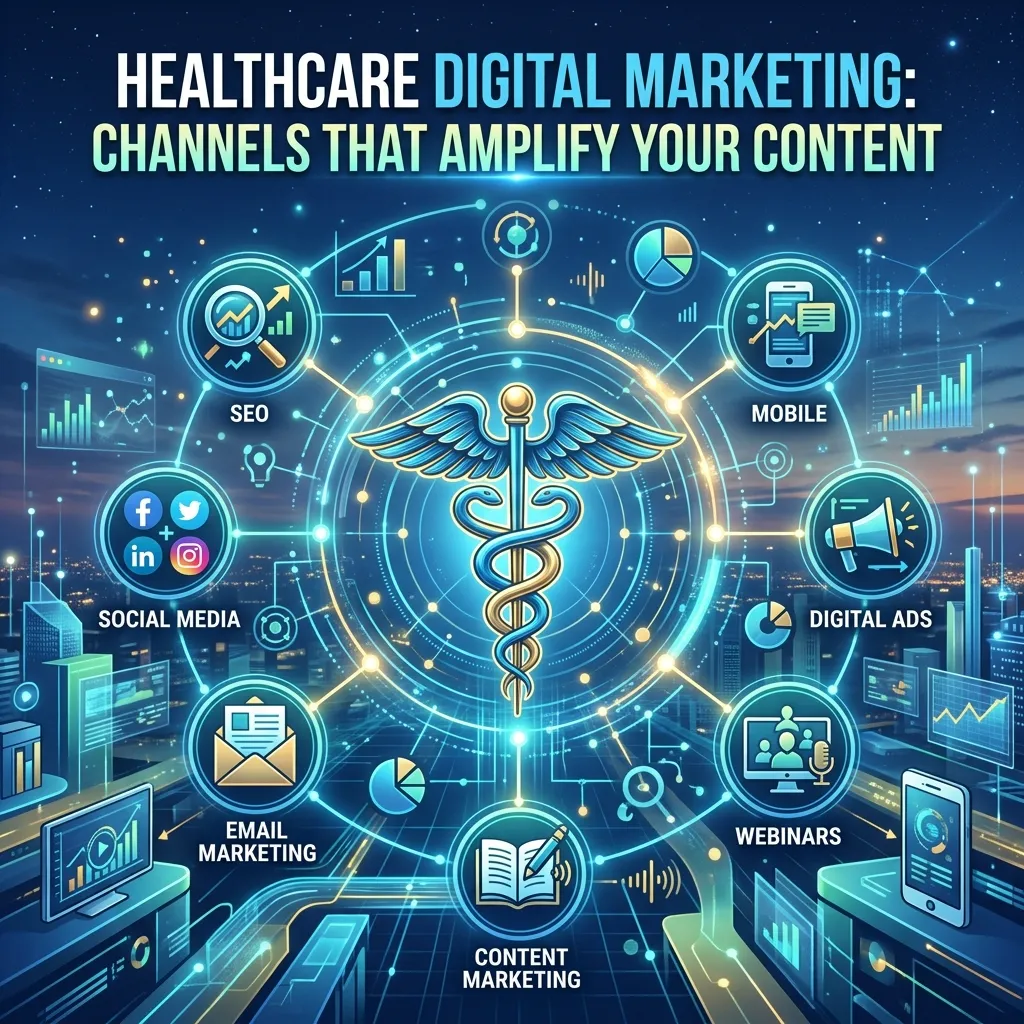
Healthcare Digital Marketing: Channels That Amplify Your Content
Email Marketing for Patient Engagement
Email remains one of the highest-ROI channels in healthcare digital marketing. A monthly newsletter featuring seasonal health tips, provider spotlights, and appointment reminders keeps your organization top of mind between visits. Segmented campaigns—tailored to specific patient populations like new parents, seniors, or post-surgical patients—perform significantly better than blanket sends.
Social Media and Video Content
Short-form video is increasingly dominant across platforms. A cardiologist explaining the warning signs of heart disease in 60 seconds, or a physical therapist demonstrating a safe stretching routine—these formats build credibility while reaching audiences who might never visit your blog directly.
Platforms like YouTube, Instagram, and even TikTok have demonstrated effectiveness for health education content, particularly for reaching younger demographics who may be establishing primary care relationships for the first time.
Paid Amplification of Organic Content
Healthcare inbound marketing doesn’t mean abandoning paid media entirely. Promoting high-performing organic content through targeted paid campaigns—particularly on Google and Meta—extends your reach to audiences who haven’t yet discovered your organization. This hybrid approach often outperforms standalone paid campaigns because the content itself has already been validated by organic engagement.
Healthcare Marketing Trends Shaping the Next Five Years
AI-Powered Personalization
AI tools are enabling healthcare organizations to deliver content tailored to individual patient needs at scale. From dynamic website experiences that surface relevant content based on browsing behavior, to AI-assisted chatbots that answer common health questions, personalization is moving from a differentiator to an expectation.
Generative AI Search and AEO
Patients increasingly get health information from AI-powered platforms like Google’s AI Overviews, ChatGPT, and Perplexity. Healthcare organizations that optimize for Answer Engine Optimization (AEO) and Generative Engine Optimization (GEO)—by creating concise, authoritative, fact-dense content—will be cited more frequently in AI-generated responses. This represents a significant and growing channel for healthcare provider visibility.
Mental Health and Preventive Care Content
Consumer interest in mental health, preventive wellness, and lifestyle medicine is surging. Healthcare organizations that develop content in these areas—rather than focusing exclusively on acute care—will attract patients earlier in the care journey and build longer-lasting relationships.
Voice Search Optimization
Smart speakers and voice assistants are now common in homes across the country. Patients ask voice assistants health questions daily. Structuring content to answer conversational queries (“What should I eat after gallbladder surgery?”) positions your organization to capture this growing search behavior.
Start Building a Content Strategy That Earns Patient Trust
Healthcare content marketing isn’t a campaign—it’s a commitment. The organizations that do it best approach content as a long-term investment in community health and institutional credibility, not a short-term traffic tactic.
Start by auditing what you already have. Identify gaps between the questions your patients are asking and the content you’ve published to answer them. Prioritize topics with the highest patient impact and clearest search demand. Build a realistic publishing cadence—consistency matters more than volume. And make sure every piece of content is reviewed for clinical accuracy before it goes live.
The payoff is compounding. Each well-optimized article, each helpful patient guide, each shareable video adds to a library that works for your organization 24 hours a day—answering questions, building trust, and bringing patients through the door.
Frequently Asked Questions
What types of content work best for healthcare providers?
The most effective content for healthcare providers includes condition and symptom explainers, patient education guides, physician profiles, FAQ pages, and procedure overviews. Video content also performs strongly, particularly for complex topics that benefit from visual explanation. The best format depends on your audience’s preferences and the platform where the content will be distributed.
How does healthcare SEO differ from standard SEO?
Healthcare SEO operates under stricter quality standards than most industries. Google classifies health-related content as “Your Money or Your Life” (YMYL), meaning it applies heightened scrutiny to accuracy, authorship, and trustworthiness. Healthcare providers must ensure content is clinically reviewed, properly cited, and authored or endorsed by qualified professionals to meet E-E-A-T (Experience, Expertise, Authoritativeness, Trustworthiness) standards.
How can hospitals stay HIPAA-compliant in their content marketing?
HIPAA compliance in content marketing primarily concerns patient data. Healthcare organizations should avoid using individually identifiable patient information in content without explicit written consent, ensure email marketing platforms meet healthcare data security standards, and work with legal counsel to review patient testimonials and case studies before publication.
How long does it take to see results from healthcare content marketing?
Content marketing is a long-term investment. Most healthcare organizations begin seeing measurable organic traffic improvements within 3 to 6 months of consistent publishing. Significant business impact—measured in appointment bookings or patient acquisition—typically becomes visible between 6 and 12 months, depending on the competitiveness of your market and the quality of your content.
What is the difference between healthcare inbound marketing and traditional healthcare advertising?
Traditional healthcare advertising pushes messages out to a broad audience through channels like TV, radio, and display ads. Healthcare inbound marketing attracts patients by providing content they’re actively searching for—such as symptom guides, treatment comparisons, or wellness tips. Inbound marketing tends to generate higher-quality leads because the audience has already expressed intent by searching for relevant information.
Should small medical practices invest in content marketing?
Yes—particularly in local SEO and patient education content. Small practices compete most effectively in their geographic area, and locally-optimized blog posts, Google Business Profile updates, and condition-specific FAQ pages can significantly improve visibility in local search results without requiring large marketing budgets. Starting with 2 to 4 high-quality articles per month is a sustainable and effective approach for practices with limited resources.
What is Healthcare Content Marketing?
Healthcare Content Marketing is the strategy of creating and sharing valuable, accurate, and educational content to attract, engage, and retain patients while building trust in healthcare services.
Why is Healthcare Content Marketing important?
It helps healthcare organizations improve online visibility, educate patients, build credibility, increase appointment bookings, and strengthen long-term patient relationships.
What types of content work best for Healthcare Content Marketing?
Popular content includes blog posts, patient education guides, FAQs, physician profiles, videos, email newsletters, case studies, and health tips.
How does Healthcare Content Marketing improve SEO?
By targeting relevant healthcare keywords, publishing high-quality content, optimizing for search intent, and demonstrating expertise, healthcare websites can rank higher in search results.
Who should use Healthcare Content Marketing?
Hospitals, private practices, clinics, telehealth providers, medical specialists, healthcare startups, and wellness organizations can all benefit from Healthcare Content Marketing.
What is the difference between Healthcare Content Marketing and traditional healthcare advertising?
Healthcare Content Marketing focuses on educating and attracting patients through valuable content, while traditional advertising relies on direct promotional messages and paid campaigns.
How often should healthcare providers publish new content?
Publishing one to four high-quality articles each month is a good starting point, with consistency being more important than frequency.
Can small medical practices benefit from Healthcare Content Marketing?
Yes. Small practices can improve local SEO, attract nearby patients, and establish authority by publishing helpful, location-focused healthcare content.
How long does it take to see results from Healthcare Content Marketing?
Most organizations begin seeing improvements in organic traffic within 3–6 months, while significant patient acquisition results often appear within 6–12 months.
What makes a successful Healthcare Content Marketing strategy?
A successful strategy includes audience research, SEO optimization, clinically accurate information, consistent publishing, patient-focused content, and ongoing performance analysis.
